
How Is a Form of "Jelly" Indispensable For Aircraft Operations? (Aerogels)
Updated: Aug 16, 2025
Aerogel, also nicknamed “frozen smoke", is the material currently used by NASA scientists to insulate aircraft from the extremely high and low temperatures on the journey through space, as well as for space dust collection, building insulation and much more!
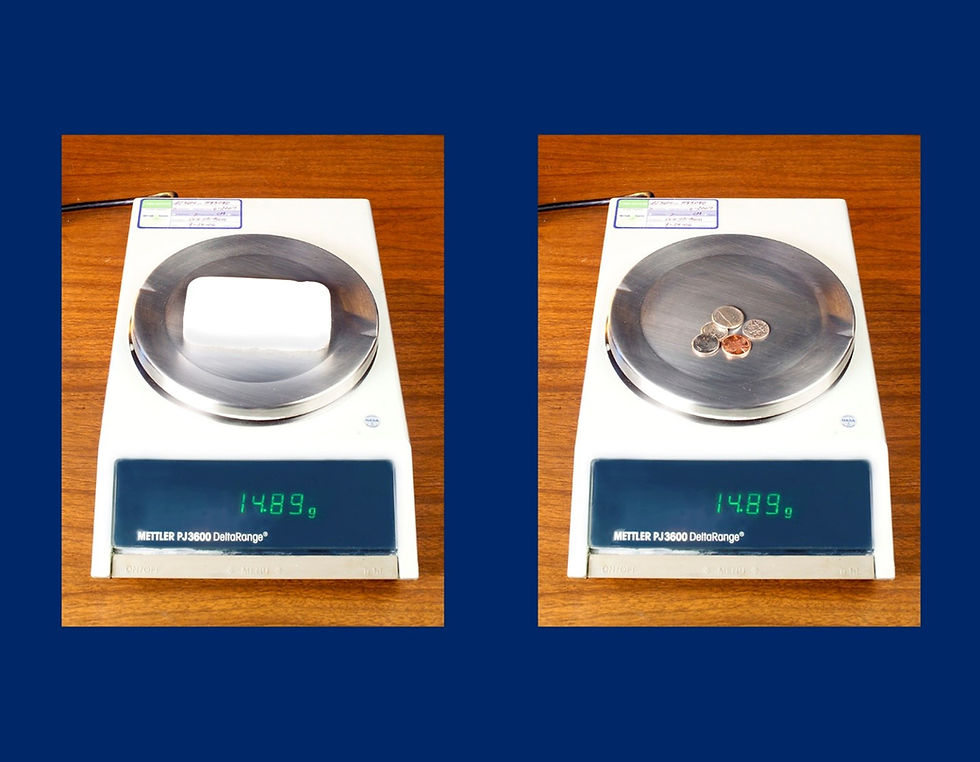
This is a very porous material (in fact, over 90% of an aerogel’s content is air). It is the most lightweight material in the world. By appearance, it is almost transparent, having a blue tint due to Rayleigh scattering.
Structure of a Gel
Surprisingly, aerogels were first invented about 25 years before the start of the Space Race and were incited by the most unexpected object – a jelly.
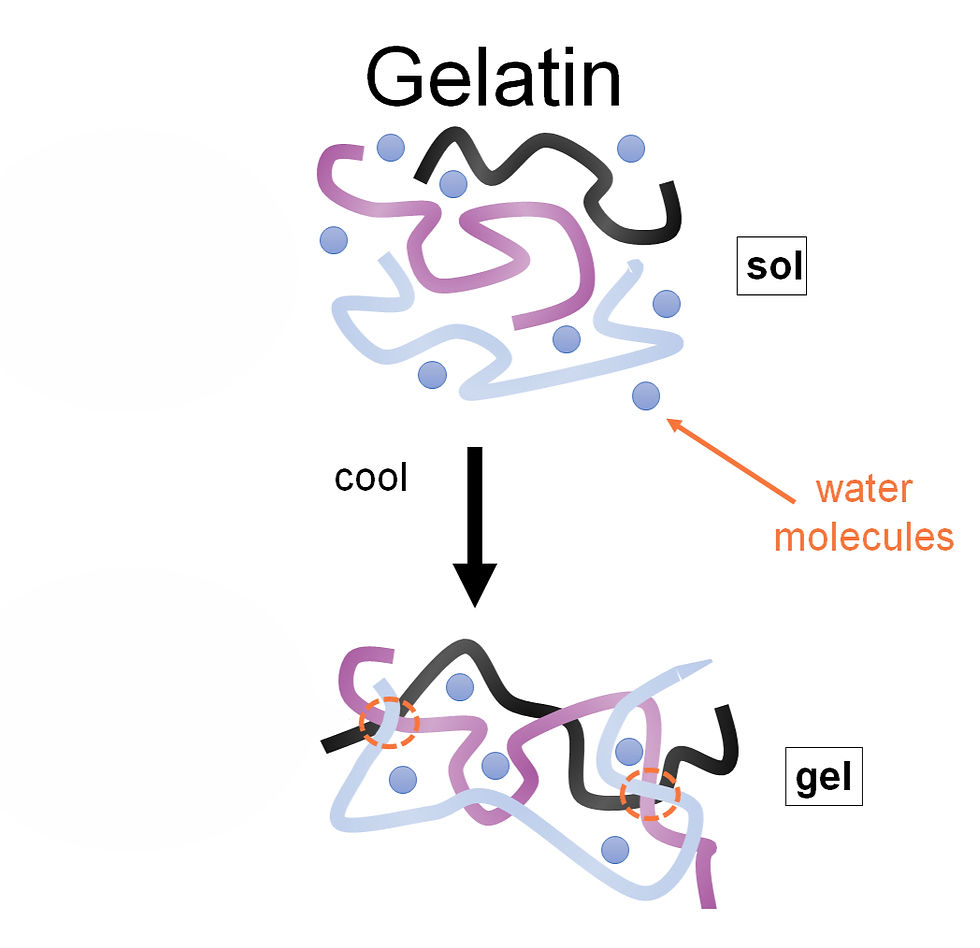
In 1931, a chemist named Samuel Kistler made a bet with his fellow colleague as to whether he would be able to replace the liquid inside a jelly jar without the main structure shrinking. Now, a jelly is comprised of water and long chains of gelatin molecules, which span the entire jelly and trap the liquid within. The water is held inside by surface tension – the force due to the cohesion of water molecules.
Surface Tension
Surface tension in water can be explained at the molecular level: throughout the liquid, the water molecules want to cling to one another and are attracted to each other via a hydrogen bond (type of intermolecular bonding). However, at the surface there are less molecules to cling to because there is air (no water molecules) above. Thus, molecules that do actually come in contact form stronger bonds with each other.

A net force is the sum of all forces acting on an object. Within water, the net force is 0 as forces from neighboring molecules cancel out. Yet, there is a net inward force on molecules at the surface since there is no force acting above. This net force makes the molecules at the surface contract and resist being stretched or broken, which is an example of tension. Surface tension be demonstrated by a needle floating on the water’s surface instead of drowning, and the force is also responsible for the formation of water drops.
In a jelly, the surface tension forces that are strong enough to prevent the liquid from escaping the jelly, but weak enough, so that a jelly can slosh around.
Creating Aerogels
The method of synthesizing an aerogel is as follows: first, the “sol-gel” process is used. A free-flowing liquid colloidal solution - a sol, is converted to a solid 3D network of molecules surrounding the liquid - a gel, as we have seen in the jelly. The difference between a sol and a non-colloidal liquid is that in a sol solid particles are dispersed throughout the liquid ,and in gel it is the other way around - liquid particles are dispersed in a solid. There are two main ways to achieve the transition from a sol to a gel, which is known as gelation. The first way is growing the nanoparticles directly in the liquid, a process favored for substances like silica aerogels. The other option is synthesizing the nanoparticles and then dispersing them in a liquid - this is how more advanced aerogels, including carbon nanotube aerogels, start out. Next, the gel is aged to increase its strength.
After that, the liquid is carefully removed from the gel using superficial drying: the temperature and pressure of the gel is increased above the critical point. The pressure is then reduced, so the liquid inside vaporizes and is removed, leaving an aerogel.
Critical Point & Superficial Fluid
The critical point is the specific temperature and pressure at which the distinction between a liquid and a gas disappears. The substance exhibits some properties of a gas (expands to fill to volume of its container and is compressible) and some properties of a liquid (density and thermal conductivity). This is called a superficial fluid.
Capillary Action in Formation of an Aerogel
Superficial drying is crucial for successful creation of aerogels because if the liquid is simply evaporated from a gel, then the structure would collapse because of capillary action. Capillary action is, in essence, surface tension. When water molecules vaporized and leave the gel, the attractive forces between these molecules pull them together to fill the empty spots and maintain the density of the gel. This causes a stress on the fragile solid network of the gel, so it collapses and shrinks.
An extension to superficial drying, developed by Dr. Arlon Hunt at Lawrence National Laboratory in 1980’s, involves the use of liquid carbon dioxide. After the gel is formed, it is left to soak in this liquid, which is at high (~58 atmospheric) pressure because that is the only condition at which carbon dioxide can exist in the liquid state. (At atmospheric pressure, solid dry ice (solid form of carbon dioxide) sublimes directly into carbon dioxide gas rather than melting.) After a period of time, about 1-14 days, carbon dioxide replaces the initial liquid inside the gel through diffusion, and the superficial drying process is then used to remove CO2 (instead of the initial liquid of the gel) and create an aerogel.
Utilizing liquid CO2 is advantageous due to its relative low cost, and the fact that CO2 is much less toxic and, hence, less dangerous, than some other substances above critical temperatures and pressures.
Additionally, freeze-drying has been utilized as an alternative to superficial drying.
Varying Aerogels
Aerogels are made of a variety of different materials, with silica aerogels being produced the most, followed by carbon and metal oxide aerogels. As an interesting fact, Kistler created aerogels not only from gelatine, but also aluminum, nickel tartrate, stannic oxide, nitrocellulose, cellulose, and egg albumin.
Properties of Aerogels
Aerogels possess some uncommon solid material characteristics, including a high surface area, very low density, strength and low thermal conductivity. This material is so good as a thermal insulator that when putting a Bunsen burner on one side of a piece of an aerogel and a flower on the other, the flower will still be conserved after a couple of minutes.

Thermal Insulation of Aerogels
Numerous, small air-filled pores inside the gel limit air movement through the material, reducing convection. Additionally, silica has a low thermal conductivity, and the air pores cause many thermal breaks (components with low thermal conductivity placed between highly-conductive parts to interrupt the thermal energy flow), which decreases conduction.
Applications
Aerogels’ properties have made them critical for many innovations:
• In 1997, NASA used silica aerogel in the Mars Pathfinder mission and has been using it ever since for spacecraft insulation. (This is due to the excellent thermal insulation and extremely light weight of the material.)
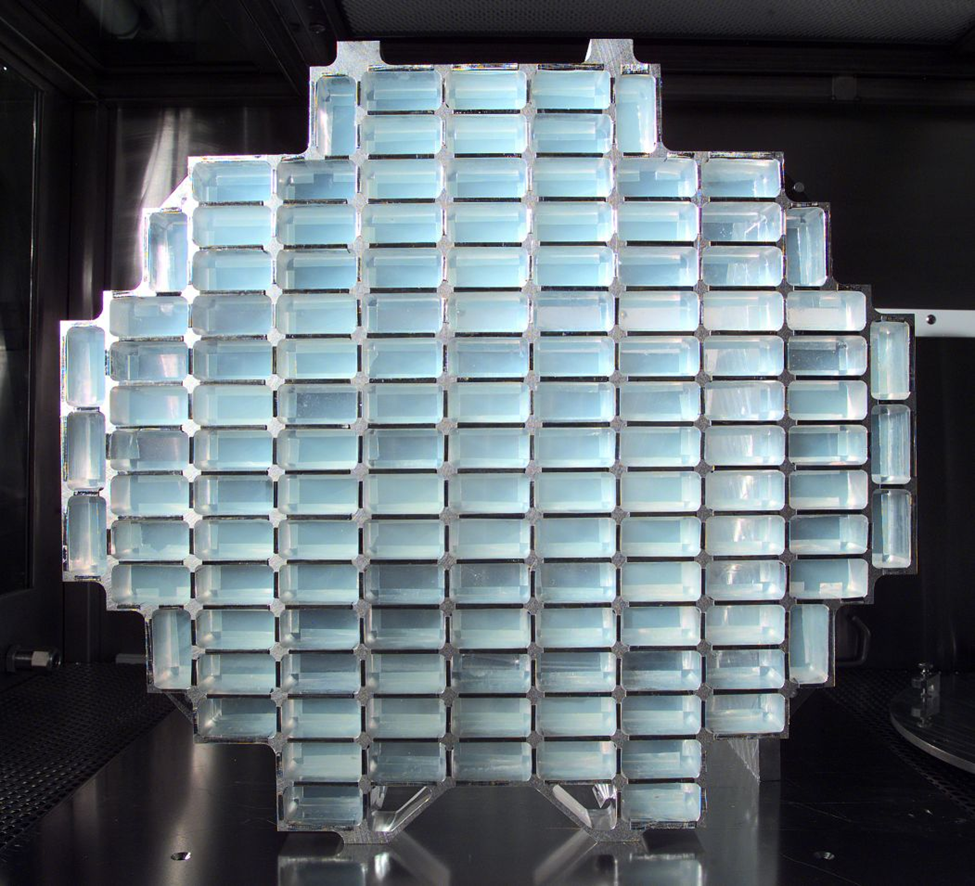
• In addition, NASA employed aerogel as a dust collector for the Stardust spacecraft (1999-2006).
• Aerogels can efficiently absorb toxic and harmful substances (contaminants) from wastewater and air, reducing pollution and slowing down climate change.
• Since 2020, aerogels have been increasingly used for fire protection of electrical vehicles’ batteries, both for preventing accidents and providing a longer escape time to the passengers.
• In the future, aerogels could be used for effective building insulation, including roof, floor, framing and even windows (as they are optically transparent). This could significantly lower energy use and cost by reducing the need of heating and cooling the indoor air.
• And even more!
Innovations
Furthermore, advances in the field of aerogels are constantly being made. Namely, NASA has developed polymer-enforced aerogels. A thin polymer layer is added to the interior surface of an aerogel, which greatly increases its strength and makes it less brittle. An even more promising innovation is creating aerogels completely out of polymers, so that they become extremely strong and flexible and can be bent into a thin film.

Resources
https://edu.rsc.org/everyday-chemistry/why-does-jelly-wobble/4015724.article
https://www.aerogel.org/?p=3#:~:text=An%20aerogel%20is%20an%20open,to%2050%20nm%20in%20diameter.
https://www.nasa.gov/aeronautics/aerogels-thinner-lighter-stronger/
https://www.aps.org/apsnews/2021/05/publication-creation-first-aerogel
https://www.idtechex.com/en/research-report/aerogels-2025-2035-technology-market-forecasts/1076
https://www.sciencedirect.com/science/article/abs/pii/S1385894716305484


Comments